Dazzler
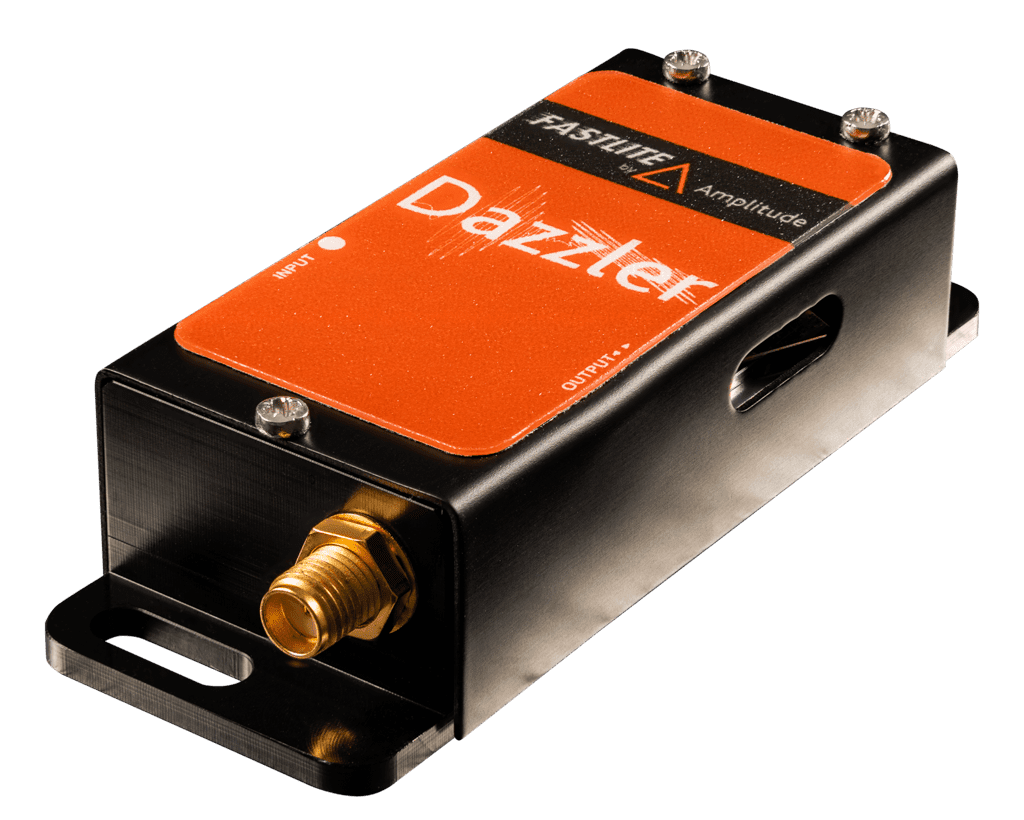
Dazzler
Description of Dazzler
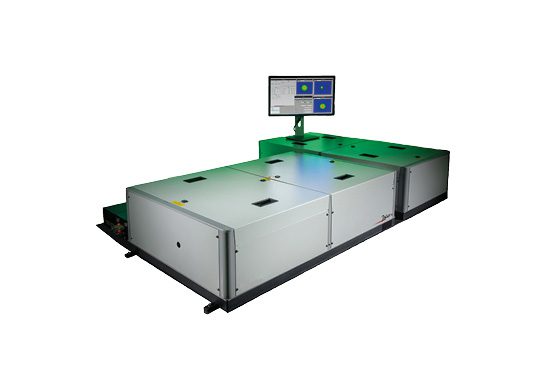
Dazzler products are complete and ready-to-use systems for shaping ultrafast laser pulses, offering simultaneous and independent control over both spectral phase and amplitude.
The core technology behind the Dazzler, also known as the Acousto-Optic Programmable Dispersive Filter (AOPDF), operates through a longitudinal interaction within a birefringent crystal.
By utilizing a polychromatic acoustic wave and a polychromatic optical wave, this interaction enables precise control over optical signals spanning the hundreds of Terahertz range. Such control is achieved by manipulating RF signals in the tens of Megahertz range.
Available Options

Specially developed for multi-dimensional spectroscopy experiments, the streaming mode allows to simultaneously load and play over 100 000 pre-defined pulse shapes at repetition rates up to 500Hz.
A typical use of this option is to scan the delay between 2 pump pulses, combined with multi-step phase cycling.
This option also provides additional synchronization outputs for easy interfacing with mechanical delay stage and detection device.
 CEP modulation
This option, included in the 19” rack generator, allows to modulate and control the CE Phase of the optical pulse at repetition rates up to 30kHz, without changing dispersion.
For single-shot and high bandwidth CEP stabilization loop of amplifiers, or interferometer stabilization.
Jitter-free
Mandatory for CEP sensitive experiments.
This option locks the internal MHz clock of the Dazzler electronics with the MHz clock of the ultrafast oscillator. As a result, optical jitter below 100 attoseconds can be achieved routinely.
High power RF amplifier
As diffraction efficiency is inversely proportional with the bandwidth, and proportional with the applied RF power, Fastlite has developed a series of High-Power RF amplifiers to ensure the maximum diffraction efficiency for octave-spanning laser pulses.
20W and 50W (exclusively in the 19” rack generator format) amplifiers, are available.
Octopuzz
The Octopuzz is an advanced synchronization tool, generating kHz-rate trigger signals divided from an internal or external MHz clock.
Logical functions between inputs and outputs allow advanced sequence management between laser, Dazzler, choppers, photodiodes, cameras, mechanical stages, etc…
The Octopuzz integrates all the needed features to manage the timings of any experiment.
Pulse compression loop
Dazzler / Wizzler combination for automated pulse compression optimization
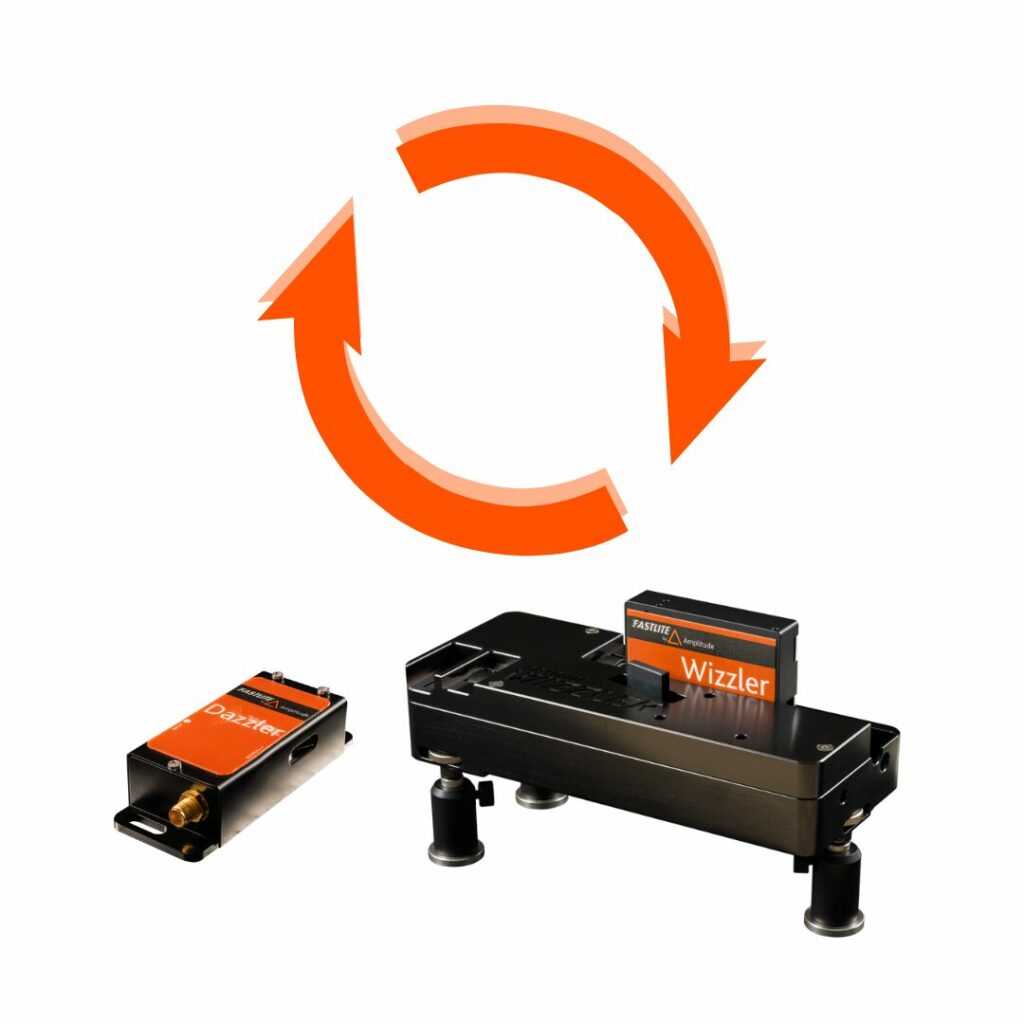
The combination of the Dazzler pulse shaping capabilities with the Wizzler high dynamic range measurement provides the most powerful compression optimization tool.
A Wizzler single shot measurement data is sent to the Dazzler software, with user-defined phase attenuation and filtering. Phase correction is then applied by the Dazzler.
With just few clicks, the Wizzler / Dazzler feedback loops warranties FTL pulses with high contrast everyday from your amplifier or your OPA with an unprecedented level of control on a dynamic range over 40dB.
Principle – Key benefits
Combining the Dazzler, located in the amplifier front-end, and the Wizzler, measuring the pulse after the final compression stage, provides the most powerful pulse compresion optimization technique.
Increase of peak power – Coherent contrast improvement
A pulse duration commonly refers to a value linked to its full width at half maximum value (FWHM). It is however well known that this parameter does not represent the quality of a femtosecond pulse, or of an ultrafast laser. Furthermore, the number of applications requiring accurate pulse characterization well beyond its FWHM has been steadily increasing over the past decade. The Wizzler, thanks to its superior dynamic range, provides the pulse duration characteristics over 40dB from the pulse peak intensity.
Fastlite, with its Wizzler product line, introduces the use of the standard deviation (sigma) of the time-intensity profile over the complete temporal window of the measurement to gain insights on the quality of your pulse. Comparing this measured value with the FTL sigma value on the same temporal window quantifies the loss of coherent contrast due to phase aberrations, and provides a good indication of the pulse compression quality at several orders of magnitude below the main peak intensity.
While performing a pulse compression optimization using the Wizzler & Dazzler feedback loop, one can observe the reduction of the standard deviation of the compressed pulse at each feedback iteration.
When the pulse is fully compressed, the measured standard deviation is lowered down to the FTL value, meaning that pre-pulses have been reduced and pulse peak intensity has been maximized.
– Upper graph: spectral domain. white: intensity, red: phase
– Lower graph: Temporal domain: white: intensity, red: FTL intensity
Day to day reproducible results
Large-scale laser systems can be quite sensitive to alignment and environmental conditions. This is one of the main reasons why experimental results are hard to reproduce from day to day.
The Wizzler / Dazzler feedback loop can re-optimize the pulse compression within few minutes with an unprecedented level of control, thus garantying the same laser temporal characteristics every day.
Adjustable loop settings to fit with any laser
Most of CPA systems operate in the saturation regime to extract more energy with a better stability. However, this adds coupling effects and non-linearities, and makes direct correction of the phase unpracticable.
With all necessary knobs and filters to balance the non-linear phase transfer and coupling effects during the laser amplification process, the Dazzler-Wizzler feedback loop has proved its effectiveness on more than a 100 lasers systems worldwide.
CEP stabilization loop
Dazzler / Fringeezz combination for multi-kHz, single-shot CEP stabilization
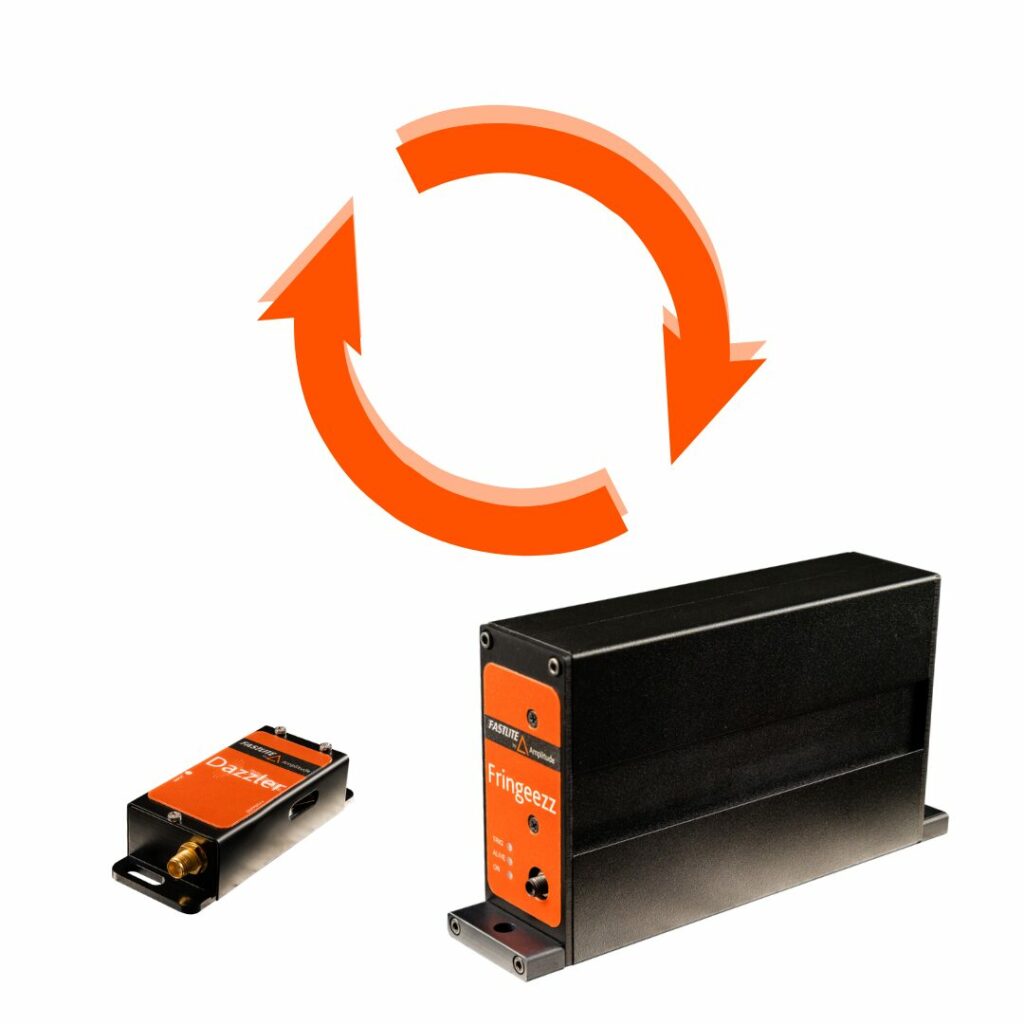
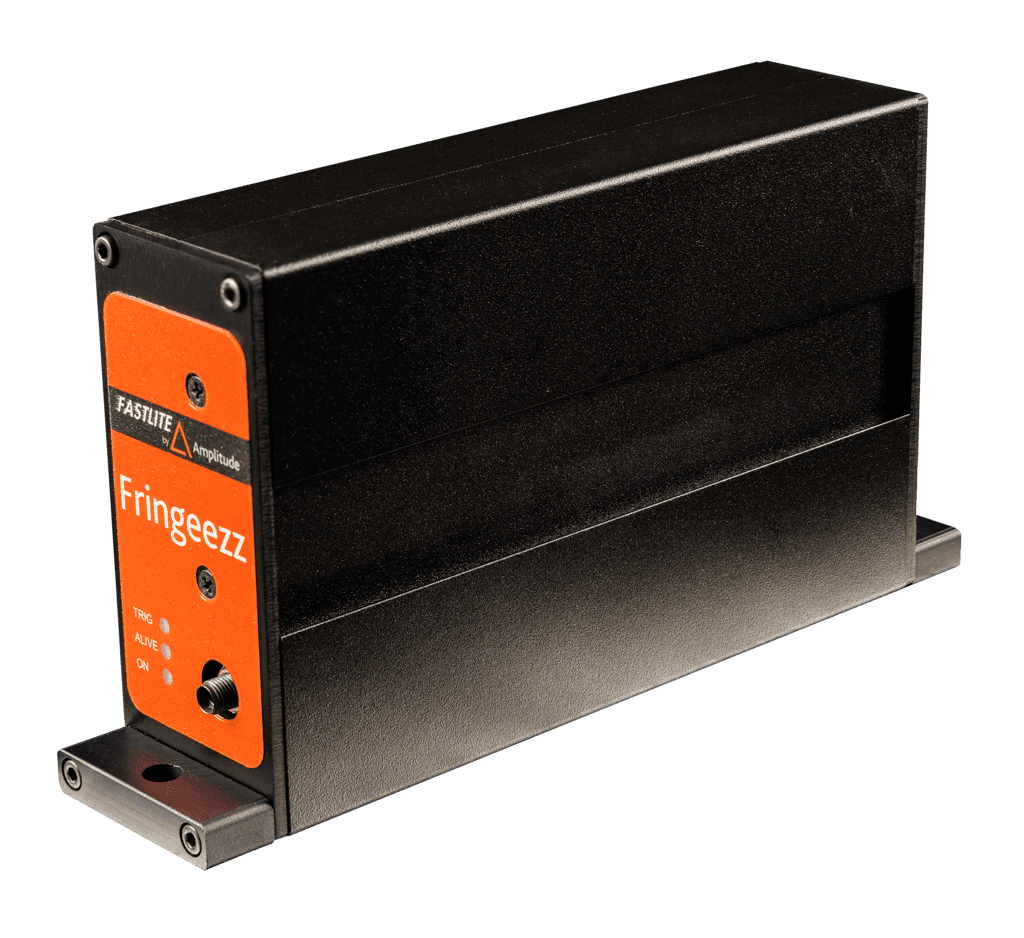
The combination of the Dazzler or high repetition rate Dazzler shot to shot and dispersion-free CEP control, with the multi-kHz single-shot CEP detection of the Fringeezz allows to build high bandwidth Carrier Envelope Phase stabilization loops.
The ultimate CEP control for Ti:Sa amplifiers, OPCPAs or other CEP-compatible systems, as well as for high-stability interferometers.
Principle – Key benefits
The Fringeezz measures the Carier Envelope Phase noise encoded in the interferogram produced by a f-to-2f setup. The plug & play connection with the Dazzler CEP control module allows multi-kHz retroaction on the CEP, without any alteration of the pulse compression.
Plug & play
Although the Fringeezz can be used with any high speed and high accuracy CEP actuator, its combination with the Dazzler CEP control module is effortless, providing almost instantaneaously dramatic improvement of the CEP stability.
Up to 5kHz retroaction bandwidth – Loop efficiency demonstrated on 100kHz systems.
Since the Fringeezz measures the CEP error for all laser shots at repetition rates up to 10kHz, The retroaction bandwidth can be as high as 5kHz, thus eliminating most of the frequency noise contributions. Indeed, the Power Spectral Density data of a closed loop system evidence a residual white noise structure: all distinctive drifts and noise contributions from mechanical or atmospheric origin have been eliminated.
Although the Fringeezz extract the CEP error value every 100µs, the application of the Dazzler/Fringeezz feedback loop is not limited to sub 10kHz systems. With its ability to perform single pulse measurement at 100kHz, coupled with the filtering possibilities of the feedback process, sub 100mrad single-shot stabilization has already been demonstrated on our 100kHz OPCPA systems.
Applications
CPA or OPCPA Carrier Envelope Phase stabilization
The Dazzler / Fringeezz feedback loop has already demonstrated record CEP stability values on Fastlite high flux MIR OPCPA systems.
Below are open loop/closed loop and on/off PSD CEP data obtained on a 100kHz OPCPA system at 3µm.
Interferometer stabilization
Polarization shaping experiments, or coherent pulse synthesis, require to separate and then recombine broadband optical pulses with an excellent phase stability.
The Dazzler / Fringeezz feedback loop is the ideal tool for this application.
Data below shows the result of a Mach-Zhender interferometer stabilization at 7kHz, resulting in a sub 25mrad rms phase noise (single-shot).
CEP versus time.
red: open loop, black: closed loop: 25mrad rms single shot Power Spectral Density
red: open loop, black: closed loop
Features of Dazzler
| Specifications | UV | VIS | NIR-SWIR | NIR-SWIR | SWIR |
|---|---|---|---|---|---|
| Model | Qz | WE25 | HR25 | HR45 | WB45 |
| Wavelength tuning range (instantaneous bandwidth) | 250 - 400 nm | 460 -950 nm | 650 - 1700 nm | 650 - 3000 nm | 2000 - 3700 nm |
| Spectral resolution | 0.1 at 250 nm | 0.2 at 500 nm | 0.3 at 800 nm | 0.1 at 650 nm | 3.5 at 2500 nm |
| Maximum programmable delay (ps) | 4 at 250 nm | 9 at 500 nm | 8 at 800 nm | 14 at 900 nm | 5.5 at 2800 nm |
| Standard diffraction efficiency | 20 % at 250 nm / 10 % at 400 nm | 30 % on a 100 nm bandwidth | 25 % on a 100 nm bandwidth | 25 % on a 200 nm bandwidth | 25 % on a 400 nm bandwidth |